

You’ll hear the same conversations: what’s the best workout, what should I eat, should I be doing more cardio?
These are reasonable questions. But they all assume the same thing—that the primary variable is what you’re doing.
It’s not.
As outlined in this 2024 article by Drăgoi, et al., there’s a deeper variable most people ignore, and it quietly determines how effective all of those decisions will be:
When you do them.
You Are a Rhythmic Organism
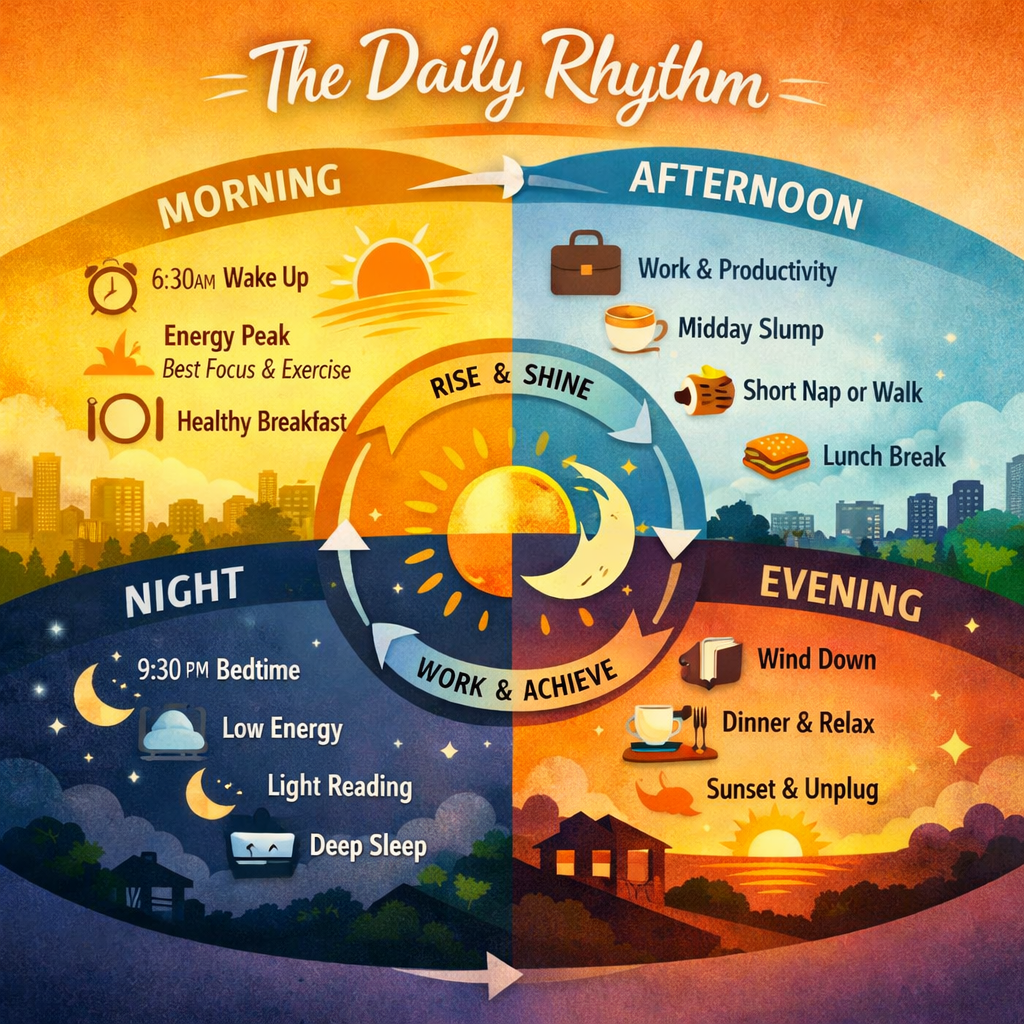
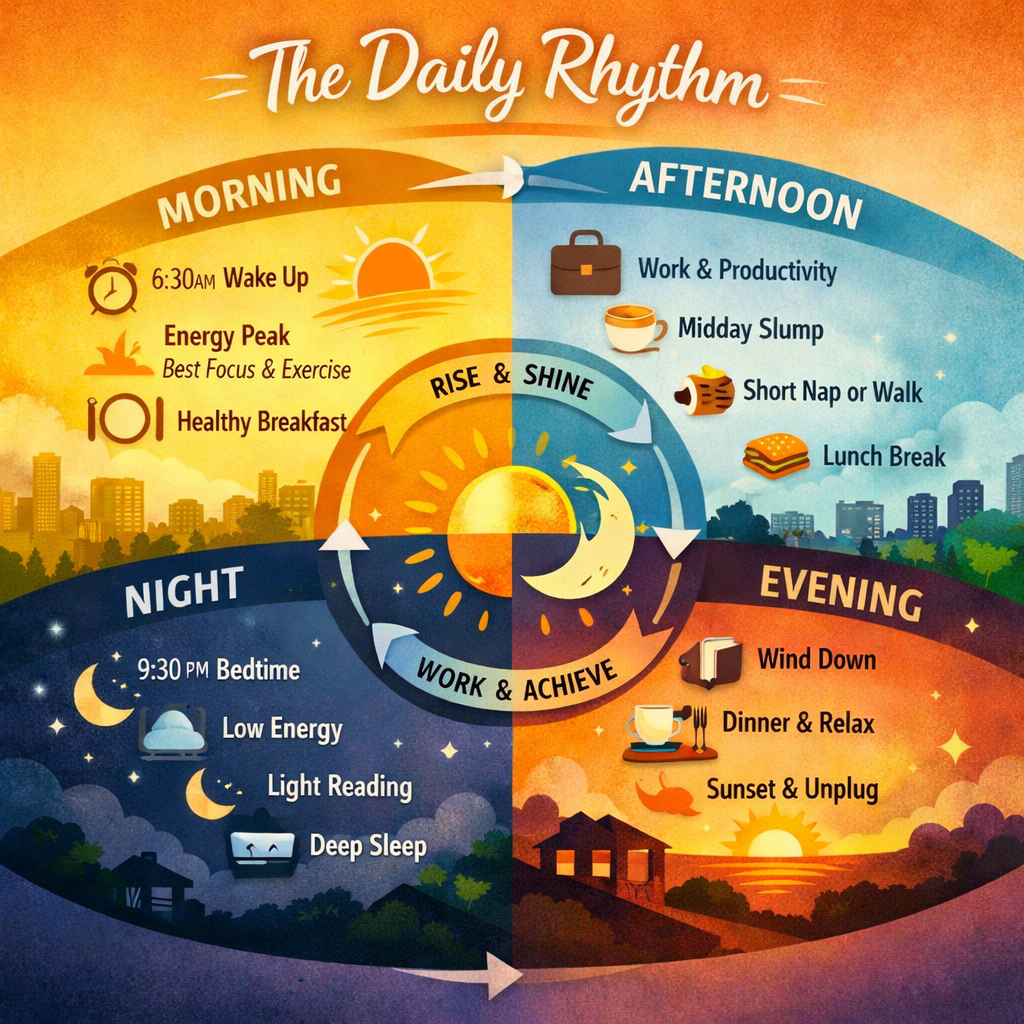
Your body is not operating randomly from one day to the next. It runs on a structured, internally generated cycle—your circadian rhythm—that governs everything from hormone release to energy levels to how well you recover from a workout.
Cortisol rises to wake you up. Melatonin rises to help you sleep. Insulin sensitivity fluctuates across the day. Even your physical and cognitive performance follow predictable patterns.
This is not abstract theory—it’s foundational biology. When these rhythms are aligned with your behavior, the system runs smoothly. When they’re not, things begin to drift. Sleep becomes inconsistent. Energy fluctuates. Hunger signals feel unreliable. Progress stalls.
Modern life has made this misalignment almost normal. Artificial light, irregular schedules, late meals, inconsistent training—these aren’t just lifestyle quirks. They are inputs that confuse a system designed for rhythm. And over time, that confusion carries real physiological consequences.
Cortisol Isn’t the Enemy—Chaos Is
Cortisol has become a convenient villain in the fitness and wellness space. But cortisol is not the problem. In fact, a healthy cortisol rhythm is essential.
It should rise in the morning, giving you alertness and drive. It should taper gradually throughout the day. By the evening, it should be low enough to allow melatonin to take over and initiate sleep.
The issue is not high cortisol. The issue is disorganized cortisol.
When wake times drift, meals are erratic, and sleep is inconsistent, the signal becomes noisy. Cortisol rises when it shouldn’t and lingers when it should fall. What people experience as “stress” is often just a system that has lost its timing.
The solution is not to suppress cortisol. It’s to restore rhythm.
Performance Has a Clock Too
Most people have experienced this without realizing it. Some workouts feel sharp and powerful. Others feel flat, even when nothing obvious has changed.
That variability is not random.
Your body temperature, neuromuscular efficiency, and metabolic systems all oscillate throughout the day. Strength and power tend to peak later in the day. Reaction time and cognitive function fluctuate with circadian timing. There are predictable highs and lows built into your physiology.
This doesn’t mean you need to engineer the perfect training time.
It means your body benefits from consistency. When you train at roughly the same time most days, your system begins to anticipate that demand. It prepares for it. Over time, performance becomes more stable, not because you optimized the clock, but because you respected it.
Chrononutrition: Your Metabolism Keeps Time
We tend to reduce nutrition to composition—macros, calories, food quality. All of that matters. But there is another layer that is often ignored: timing.
Your ability to handle glucose is not constant throughout the day. Hormones involved in metabolism follow circadian patterns. Your body is more metabolically prepared to process food during certain windows than others.
When eating patterns are erratic—skipping meals, grazing late into the night, inconsistent timing—you introduce unnecessary friction into the system. Energy becomes less predictable. Hunger cues become less reliable. Over time, this contributes to the same sense of instability people often attribute to “slow metabolism.”
The goal is not rigid scheduling. It is predictable structure. Your body performs better when it knows when to expect fuel.
Exercise Is a Clock Reset Button
Exercise is often framed purely as a tool for burning calories or building muscle. It is both of those things. But it also serves a more foundational role.
It is one of the most powerful signals you can give your body to reinforce your internal clock.
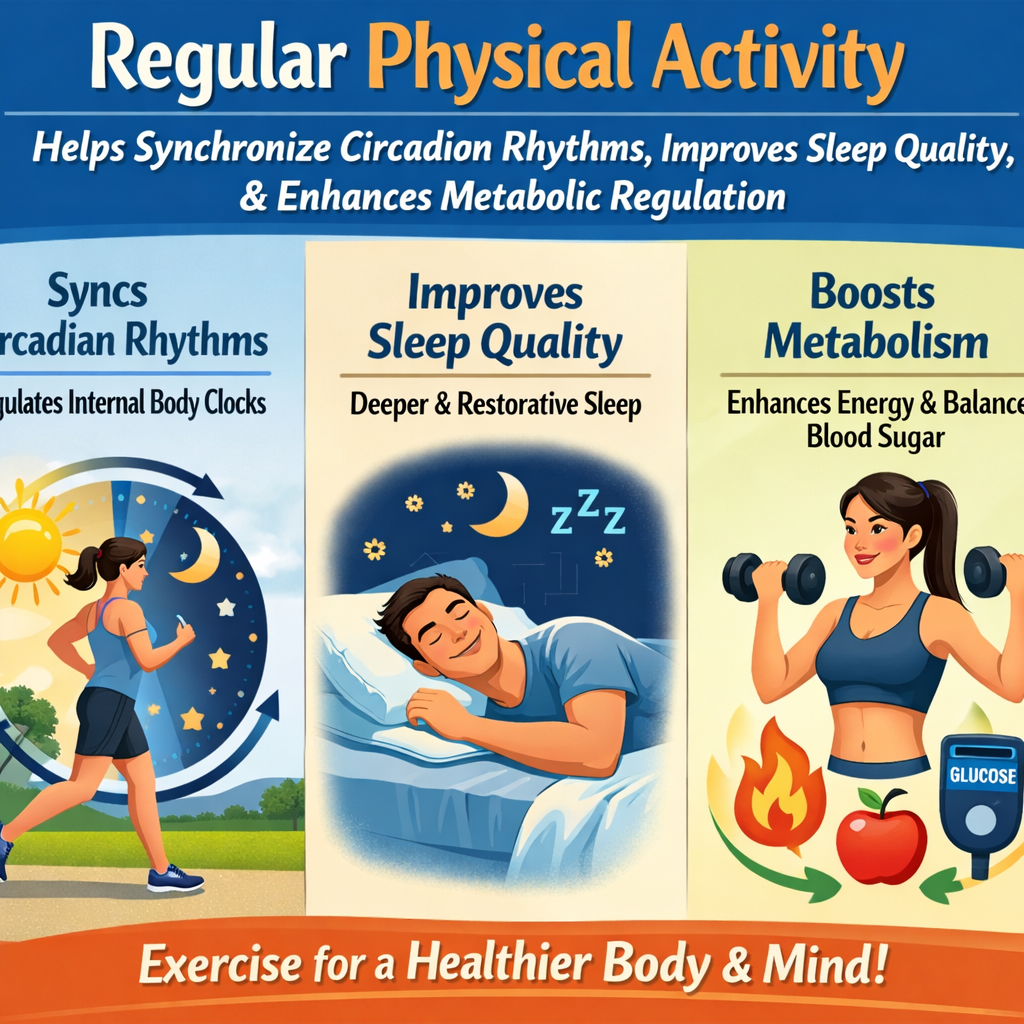
Regular physical activity helps synchronize circadian rhythms, improves sleep quality, and enhances metabolic regulation. It acts as a daily anchor—something your physiology can organize around.
This is why consistent training tends to spill over into other areas of life. People sleep better. They eat more regularly. Their energy stabilizes. It’s not just behavioral momentum. It’s biological alignment.
The FITNESS SF Approach: Build a Daily Rhythm
Wake Time:
Keep this within ±30 minutes every day
→ This is your anchor for everything else
First Movement (within 1–2 hours):
Walk, lift, mobility work
→ Signals to your body: “We’re active today”
Meal Timing:
Keep meals within consistent 1-hour windows
→ Stabilizes metabolism and energy
Training Time:
Same general time of day most days
→ Builds physiological consistency
Wind-Down Routine:
Dim lights, reduce screens, slow things down
→ Allows melatonin to rise naturally
Bedtime:
Again, ±30 minutes
→ Sleep consistency > sleep perfection
Why This Works
When your behavior aligns with your biology, the system simplifies.
Sleep becomes deeper and more restorative. Hormones follow predictable patterns. Energy becomes more stable. Hunger signals become clearer. Recovery improves.
Even at the cellular level, systems tied to oxidative stress and recovery follow circadian patterns. Your ability to adapt to training is not just about what you do—it is about when your body is prepared to respond.
This is the difference between constantly pushing your body and actually working with it.
The Big Idea
Most people are trying to optimize inside of a disorganized system.
That approach will always have limits.
You don’t need a more complicated plan. You need a more consistent one.
Because once your rhythm is in place, everything else—training, nutrition, recovery—starts to work better.
Bring It Back to FITNESS SF
At FITNESS SF, we don’t just coach workouts. We coach structure.
A great program layered on top of a chaotic lifestyle will always underperform. But when training, nutrition, and recovery are organized around a consistent daily rhythm, the results compound.
If your energy feels unpredictable, your sleep inconsistent, or your progress stalled, don’t immediately look for a new program.
Start with your day.
Or better yet, schedule a FIT session and let a coach help you build a structure that actually fits your life—one your body can recognize, adapt to, and thrive in.
Because the goal isn’t perfection.
It’s rhythm.
The content on this blog was written with the assistance of AI and is provided for general informational purposes only. It does not constitute medical advice. No responsibility or liability is assumed for any actions taken based on the information provided.