
Aging changes the body — but decline is not inevitable.
Two of the most important (and most misunderstood) drivers of loss of independence in later life are frailty and fragility fractures. Frailty is not simply “getting older.” It is a measurable decline in muscle strength, mobility, balance, and physiologic resilience. Fragility fractures — often occurring from a simple fall from standing height — are frequently the downstream consequence.
A 2023 review in Current Osteoporosis Reports makes something very clear: appropriately prescribed exercise is one of the most powerful tools we have to prevent and manage both frailty and fragility fractures.
At FITNESS SF, this isn’t theory. It’s programming.
Frailty: The Pre-Disability State
Frailty is characterized by decreased strength, slower walking speed, low physical activity, exhaustion, and unintentional weight loss. It is often described as a pre-disability state — meaning it precedes loss of independence.
Frailty significantly increases the risk of falls, hospitalization, and mortality. It also overlaps closely with sarcopenia (loss of muscle mass) and osteoporosis. Individuals with both low muscle mass and low bone density are dramatically more vulnerable to poor outcomes.
In other words, muscle and bone health cannot be separated. When one declines, the other often follows.
Fragility Fractures: A Predictable Outcome of Inactivity
Nearly one in two women and one in four men over age 50 will experience an osteoporotic fracture during their lifetime. The hip and spine are particularly high-risk areas, and hip fractures in particular can be life-altering. Many older adults never regain their prior level of independence after one.
Importantly, about 90% of hip fractures occur after a fall. That means fracture prevention is not just about bone density — it’s also about balance, strength, and mobility.
And here is where exercise becomes medicine.

Walking Is Not Enough
Aerobic activity supports cardiovascular health, and we strongly encourage it. But research consistently shows that aerobic exercise alone does little to prevent sarcopenia or significantly improve bone mineral density.
To meaningfully impact aging physiology, exercise must be structured and progressive.
International clinical guidelines consistently recommend multicomponent exercise programs that include progressive resistance training, weight-bearing impact exercise, balance and mobility training, and posture work.
This is not random movement. It is intentional loading.
Progressive Resistance Training: The Foundation
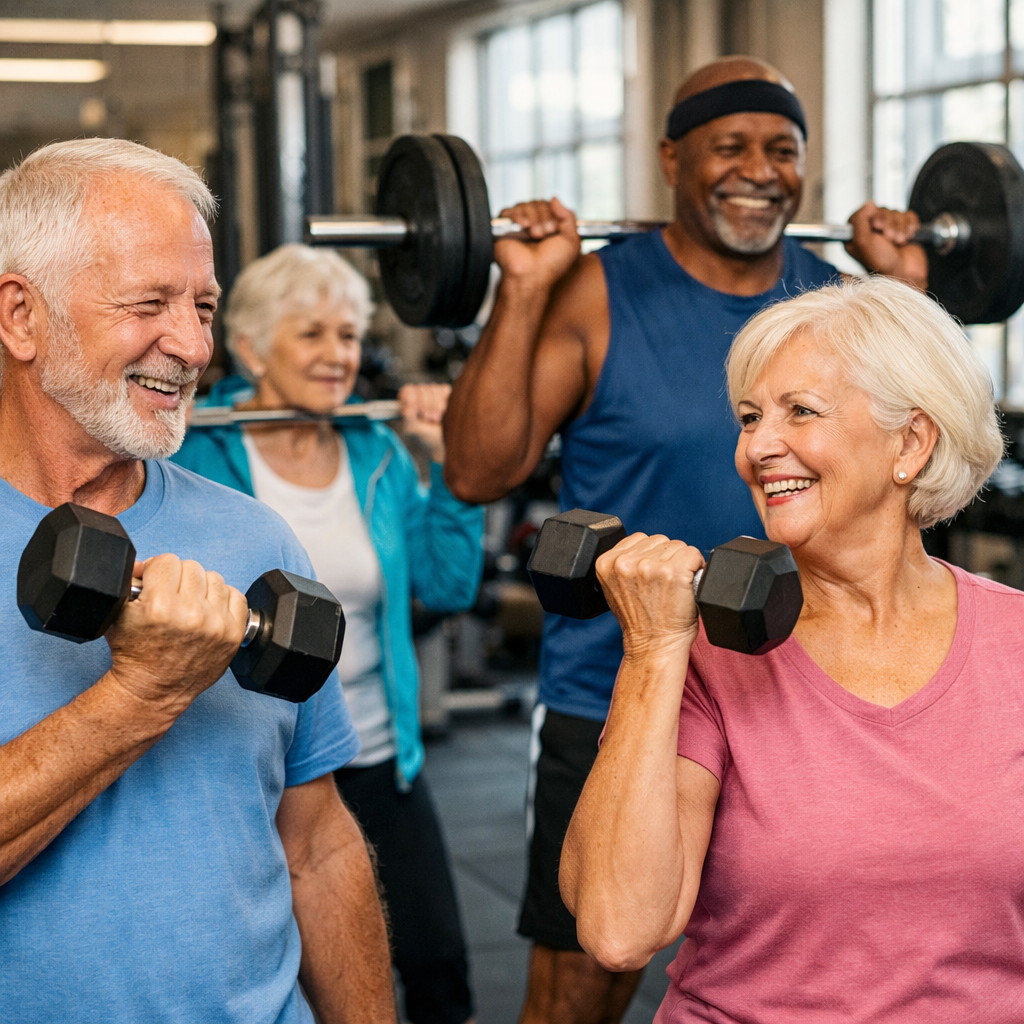
Progressive resistance training (PRT) is the most effective strategy for maintaining or improving muscle mass and strength in older adults. It works because muscle adapts to stress. When resistance increases gradually over time, the body responds by building strength and improving neuromuscular coordination.
Guidelines suggest strength training at least two days per week, using multiple exercises that challenge major muscle groups. The principle is simple: muscles must be asked to do more than they are accustomed to doing.
For members over 50 — or anyone concerned about longevity — resistance training is not optional. It is protective.
Bone Needs Load, Not Just Motion
Bone responds to mechanical strain. Research suggests that moderate-to-high intensity loading is required to stimulate improvements in bone mineral density. In fact, higher-intensity resistance and impact programs have demonstrated meaningful improvements in spine and hip bone density in older adults, with high adherence and strong safety profiles.
Low-intensity activity and casual walking simply do not create enough stimulus for bone adaptation.
Bone adapts to force — not to steps.
Balance Training: The Hidden Multiplier
Because most hip fractures occur after a fall, balance training becomes a powerful fracture-prevention strategy. Large systematic reviews show that exercise programs emphasizing balance and functional training reduce falls by roughly 24–34% in older adults.
Balance is trainable. Reaction time is trainable. Coordination is trainable.
This is why structured single-leg work, mobility progressions, and functional strength training are core components of evidence-based longevity programming.

Nutrition: The Accelerator
Exercise is the stimulus. Nutrition is the substrate.
Research shows that adequate dietary protein intake enhances the benefits of resistance training, particularly in individuals with low baseline intake. Clinical recommendations often suggest protein intake in the range of 1.0–1.2 grams per kilogram of body weight per day for older adults (in the absence of chronic kidney disease), alongside sufficient calcium and vitamin D.
Strength without nutrition is incomplete. Nutrition without strength training is underpowered.
The combination is where transformation happens.
The Bigger Picture: Aging Is Adaptable
Frailty and fragility fractures are strongly linked to sedentary behavior and physical inactivity. That means they are, at least in part, preventable.
The consensus across international guidelines is clear: individualized, supervised, multicomponent exercise programs are first-line therapy for preventing frailty and fractures.
This is not extreme training. It is intelligent training.
It is programming that respects physiology and works with it.
What This Means at FITNESS SF
At FITNESS SF, our approach reflects this evidence.
We prioritize progressive strength training.
We incorporate balance and functional movement.
We scale impact safely and intelligently.
We support structured nutrition strategies.
We are not in the business of random workouts. We are in the business of long-term capacity.
If you are over 50 — or simply thinking ahead — the question is not whether you should train. The question is how intentionally you want to train.
Strong bones.
Strong muscles.
Stable balance.
Those are not cosmetic goals. They are independence goals.
If you’re ready to train for longevity, book a Fitness Assessment at FITNESS SF and let’s design a program that keeps you strong, steady, and resilient for decades to come.
The content on this blog was written with the assistance of AI and is provided for general informational purposes only. It does not constitute medical advice. No responsibility or liability is assumed for any actions taken based on the information provided.