

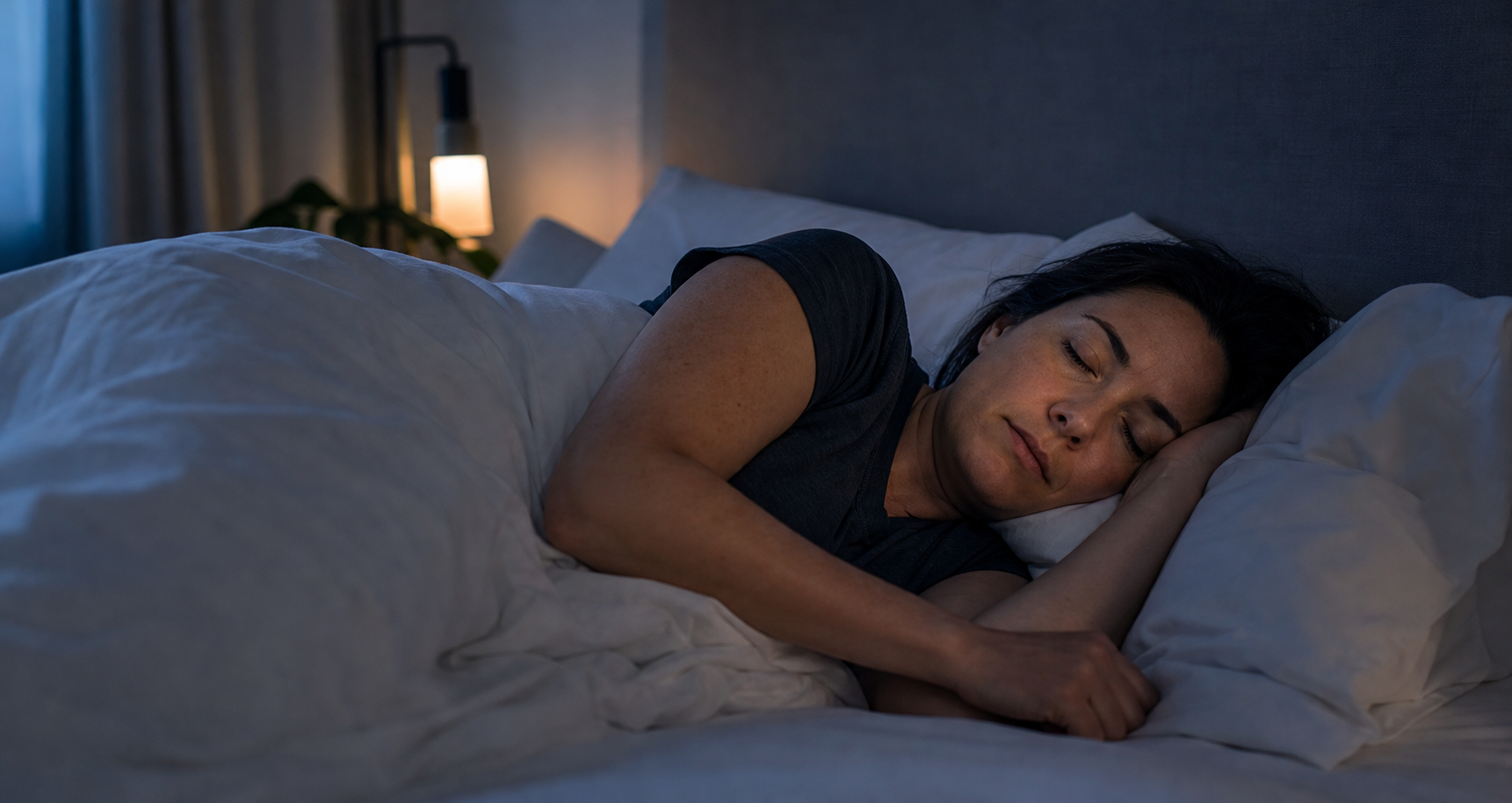
Sleep is not eight hours of biological silence. It is an organized sequence of stages, each with a different pattern of brain and body activity. Deep sleep is the slow-wave stage concentrated mostly in the first half of the night. You cannot force it with a supplement or “biohack,” but you can protect the conditions that allow it to occur.
What Is Sleep Architecture?
Sleep architecture is the structure and sequence of sleep stages across the night. It describes not only how long you sleep, but how your brain moves through light sleep, deep sleep, and rapid eye movement sleep.
According to the National Heart, Lung, and Blood Institute, a typical night contains four to six sleep cycles, each lasting roughly 80 to 100 minutes. Each cycle includes non-rapid eye movement sleep, or NREM sleep, followed by rapid eye movement sleep, or REM sleep.
NREM sleep has three stages:
- N1: the transition from wakefulness into sleep
- N2: a more stable stage in which you are clearly asleep
- N3: deep sleep, also called slow-wave sleep
REM sleep is a separate phase marked by more active brain activity, rapid eye movements, dreaming, and temporary muscle relaxation. REM deserves its own discussion. For now, the important point is that healthy sleep is not one continuous depth. It is a changing pattern.
When Does Deep Sleep Occur?
Deep sleep is N3 sleep, and most of it occurs during the first half of the night.
As the night progresses, deep sleep usually becomes less prominent and REM periods become longer. This is one reason a full night matters: the beginning and end of the night are not interchangeable.
Deep sleep is also influenced by age and sleep pressure. Children generally produce more slow-wave sleep than adults. The amount tends to decline across adulthood, sometimes substantially. After a period of extended wakefulness or sleep loss, the brain may also produce more slow-wave activity when sleep becomes available.
That does not mean you should intentionally deprive yourself of sleep to trigger a rebound. Recovery sleep is a response to lost sleep, not an upgrade over consistently adequate sleep.
What Happens During Deep Sleep?
During deep sleep, large populations of brain cells become synchronized into slow electrical rhythms. These slow waves are visible on an electroencephalogram, or EEG, and give slow-wave sleep its name.
Deep sleep is not a shutdown. It is an active physiological state.
A comprehensive 2024 review of slow-wave sleep describes its involvement in several overlapping processes:
- Newly encoded information is reactivated and reorganized as part of memory consolidation.
- Sympathetic nervous system activity decreases, supporting a more restorative physiological state.
- Growth hormone release is closely associated with slow-wave sleep and contributes to processes involved in tissue maintenance and repair.
- Sleep and immune activity interact in both directions.
- Slow-wave activity may support the brain’s waste-clearance systems, although important questions about causality and long-term clinical effects remain unresolved.
None of these functions belongs exclusively to one sleep stage. Deep sleep, lighter NREM sleep, and REM sleep work as a sequence. Treating one stage as the only sleep that matters misses the value of the complete architecture.
Why Is Deep Sleep Important for Training and Recovery?
Deep sleep supports recovery, but it is not a substitute for intelligent programming, adequate nutrition, or rest between demanding sessions.

Strength training creates a stimulus. Adaptation occurs afterward. That broader recovery process depends on sleep, energy availability, protein intake, training experience, stress, and the size of the workload.
Deep sleep participates in hormonal regulation and physical restoration, but more time labeled “deep” on a wearable does not automatically mean more muscle growth. Consumer devices estimate sleep stages from signals such as movement and heart rate; clinical sleep staging uses brain activity, eye movements, and other physiological measurements.
The practical lesson is to watch the larger pattern. Are you sleeping long enough? Are you waking repeatedly? Do you feel restored? Is performance improving? Are soreness and fatigue appropriate for the training you are doing?
A FITNESS SF personal trainer can help adjust training volume and progression when the program itself is overwhelming your ability to recover. A harder workout is not always a better workout, especially when sleep is already compromised.
What Disrupts Deep Sleep?
The most common threats are not a lack of sleep technology. They are insufficient sleep opportunity, repeated awakenings, irregular schedules, substances, and untreated sleep problems.
A Shortened Sleep Window
You cannot complete normal sleep architecture if you repeatedly give yourself too little time to sleep. Sleeping late on one weekend morning may feel helpful, but it does not fully replace a consistently adequate sleep opportunity.
Alcohol Near Bedtime
Alcohol can create sleepiness while making sleep lighter and more fragmented later in the night. It changes sleep architecture rather than improving it. Our article on why the nightcap eventually works against sleep examines that effect in more detail.
Caffeine Too Late in the Day
Caffeine blocks some of the signals that help sleep pressure become noticeable. The effect lasts longer in some people than others, so an afternoon coffee may interfere with sleep even when falling asleep still seems possible.
Noise, Light, Heat, and Interruptions
A bedroom does not need to be perfect, but repeated arousals make sustained sleep more difficult. Phone alerts, pets, children, pain, temperature, and environmental noise can all fragment the night.
Sleep Disorders and Medical Conditions
Loud snoring, gasping, witnessed pauses in breathing, persistent insomnia, restless legs, pain, reflux, medication effects, and hormonal changes can disrupt sleep. These problems are not character flaws or failures of sleep hygiene. They may require clinical evaluation.
How Can You Improve Deep Sleep?
The best strategy is to improve the conditions for complete, uninterrupted sleep rather than chasing a deep-sleep score.
The Centers for Disease Control and Prevention recommends habits that support overall sleep quality:
- Protect enough time for sleep. Work backward from the time you must wake up instead of treating bedtime as whatever remains after the day is finished.
- Keep the schedule reasonably consistent. A stable wake time helps anchor the sleep-wake cycle.
- Exercise regularly. Physical activity generally supports sleep, although people who feel stimulated by late intense training may benefit from moving those sessions earlier.
- Create a quiet, dark, comfortable room. Reduce avoidable light, noise, notifications, and temperature discomfort.
- Move caffeine earlier. Afternoon or evening caffeine is more likely to interfere with sleep.
- Avoid using alcohol as a sleep aid. Sedation is not the same as restorative sleep.
- Build a repeatable transition into bed. A predictable wind-down period makes sleep less dependent on exhaustion.
- Address persistent symptoms. If you regularly have trouble sleeping, wake unrefreshed despite adequate time in bed, or have signs of sleep apnea, talk with a qualified healthcare professional.
Should You Trust Your Deep-Sleep Score?
Use a wearable’s deep-sleep number as an estimate, not a diagnosis or a nightly grade.
A single low reading is rarely useful by itself. Sleep stages vary naturally with age, recent sleep, illness, stress, exercise, and the limitations of the device. Obsessing over the number can also make sleep feel like another performance test.
Look for patterns over time and pair the data with how you function. Persistent daytime sleepiness, repeated awakenings, declining performance, or loud snoring deserve more attention than one unusual graph.
What Is the Bottom Line?
Deep sleep is an essential part of sleep architecture, especially concentrated early in the night. It supports processes related to memory, hormonal regulation, immune function, and restoration. But it does not operate alone, and maximizing one stage is not the real goal.
The goal is a complete night: enough time, reasonable consistency, fewer disruptions, and attention to symptoms that suggest something more than a poor bedtime routine.
You do not need to perfect sleep. You need to stop treating it as the part of recovery that can always be borrowed from without consequence.
The content on this blog was written with the assistance of AI and is provided for general informational purposes only. It does not constitute medical advice. No responsibility or liability is assumed for any actions taken based on the information provided.