
Most people own a scale. Most people also know how misleading a scale can be.
One day you’re “up.”
The next day you’re “down.”
Nothing about your training changed — but the number did.
That’s because body weight alone tells you almost nothing about what’s actually happening inside your body.
At FITNESS SF, every member has complimentary access to InBody Body Composition Analysis — a technology that goes far beyond any typical bathroom scale and gives you meaningful insight into your progress.
If you have a body composition goal, InBody is a no-brainer.
Why Weight Alone Isn’t Enough
A traditional scale measures one thing: total mass.
It cannot tell you:
- Whether you gained muscle
- Lost fat
- Retained water
- Changed body composition
- Improved metabolic health
You could lose fat and gain muscle — and see no change on the scale.
You could lose muscle and gain fat — and see “progress.”
Without context, weight is noise.
InBody gives you the context.
What Makes InBody Different?
Multi-Point Contact for More Complete Measurement
Most home scales measure only through your feet.
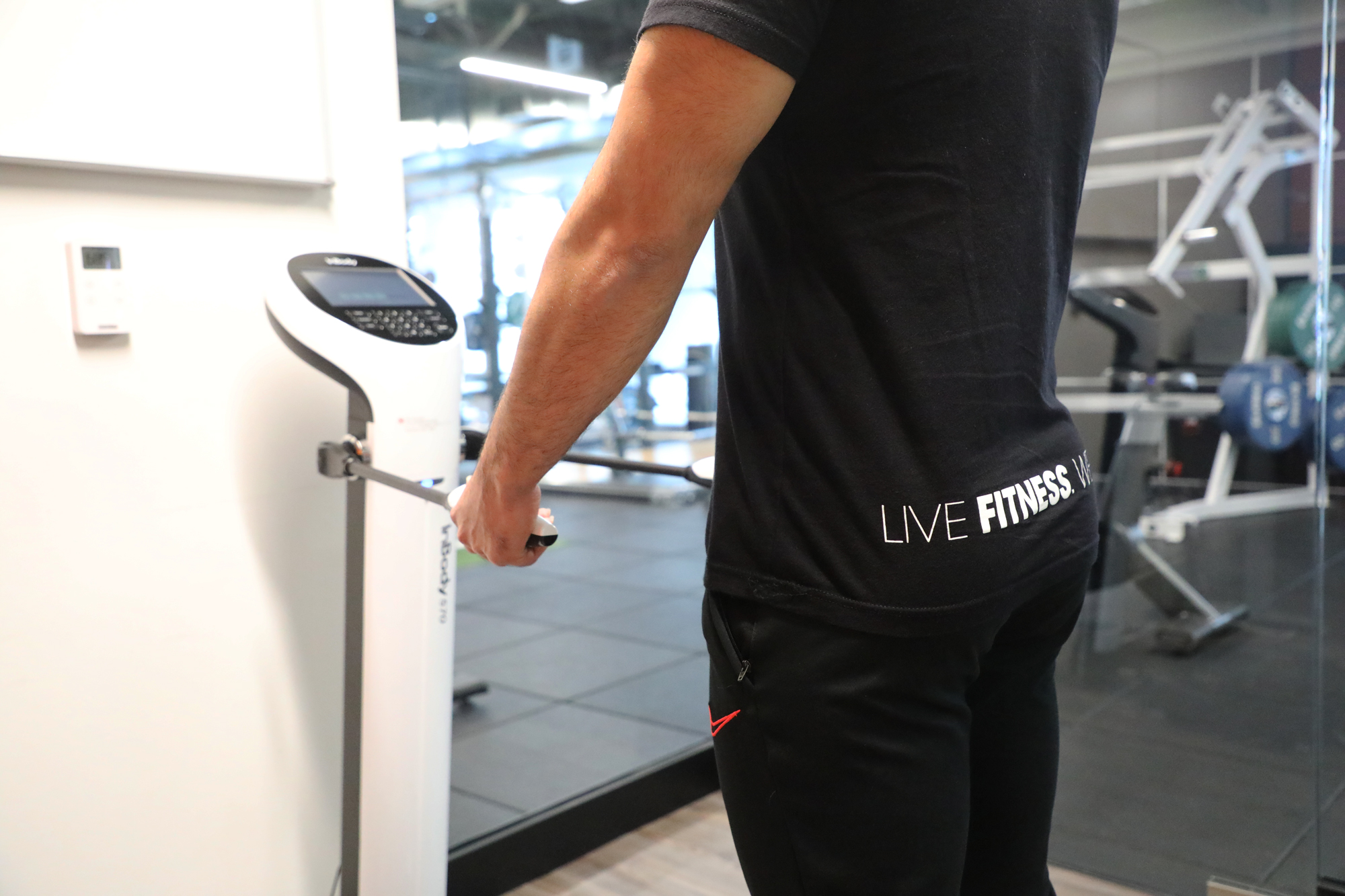
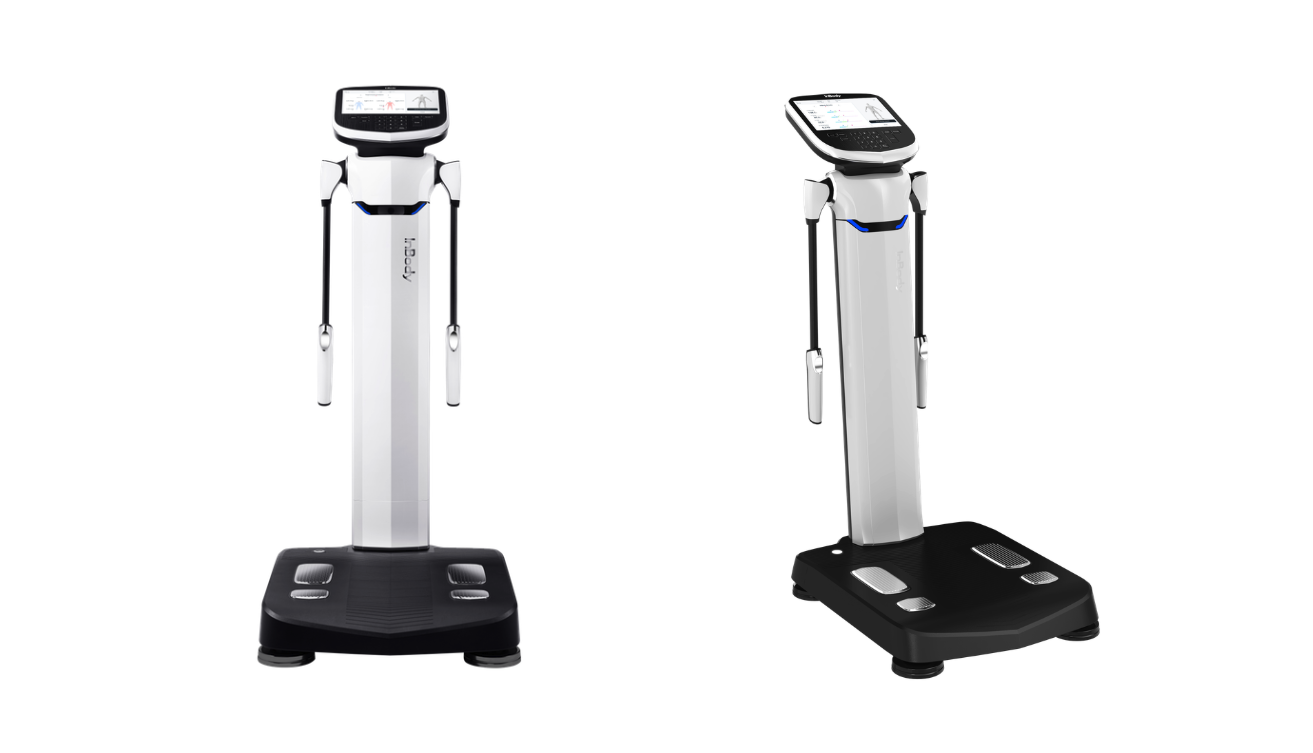
InBody uses contact points through both your hands and feet, allowing it to analyze your body in segments rather than as a single unit.
This means it can estimate composition in:
✔ Arms
✔ Legs
✔ Trunk
✔ Total body
The result is more detailed, more consistent information than a standard digital scale can provide.
How Bioelectrical Impedance Works
InBody uses bioelectrical impedance analysis (BIA).
A very low, safe electrical current passes through your body.
Different tissues interact with this current differently:
- Muscle (high water content) conducts well
- Fat resists more strongly
- Bone resists the most
By measuring how the current moves through your body, the system estimates your internal composition.
This method is widely used in fitness, performance, and health settings because it is fast, non-invasive, and practical for repeated use.
How Accurate Is InBody?
The gold standard for body composition measurement is DEXA scanning.
DEXA is highly precise, but it is expensive, requires specialized facilities, and is not practical for frequent monitoring.
InBody is not a DEXA scan — but when used properly, it provides measurements that are reasonably close and highly useful for tracking change over time.
Typical Performance
Under consistent conditions:
- Body fat estimates are often within a few percentage points of DEXA
- Lean mass measurements show strong agreement
- Long-term trends are very reliable
For most fitness and health goals, this level of accuracy is more than sufficient.
What matters most is not one perfect measurement — it’s seeing meaningful trends.
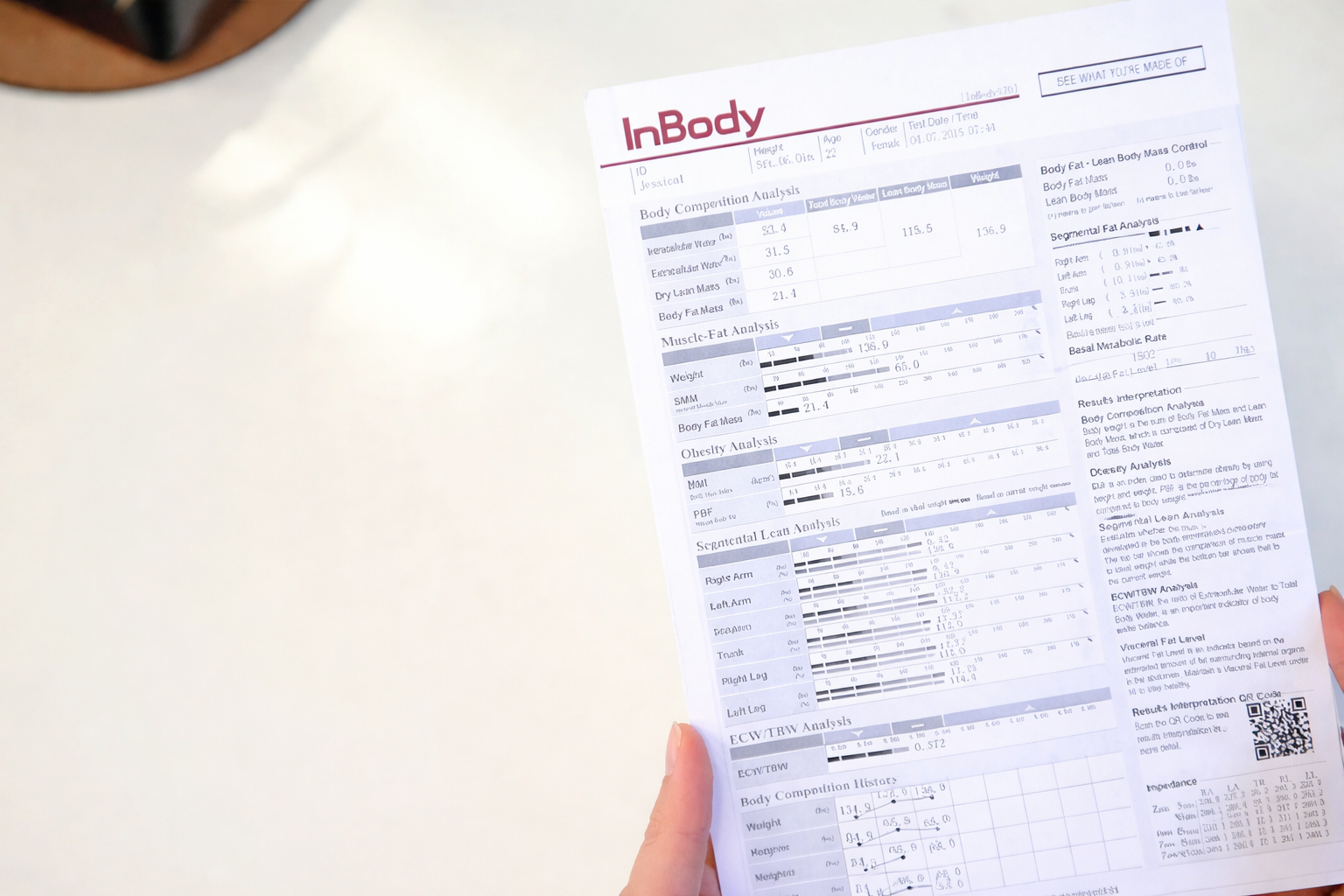
What Information Does InBody Provide?
An InBody scan gives you far more than body weight.
You’ll see detailed information about:
Body Composition
✔ Body fat mass
✔ Body fat percentage
✔ Skeletal muscle mass
✔ Lean body mass
✔ Fat-free mass
Segmental Analysis
✔ Muscle and fat in each arm
✔ Each leg
✔ Your trunk
This can help identify imbalances and guide training priorities.
Metabolic & Health Indicators
✔ Basal metabolic rate (BMR) estimate
✔ Visceral fat estimate
✔ Body water distribution
✔ Phase angle
These metrics offer insight into overall health and recovery.
Goal Tracking
✔ Weight composition changes
✔ Muscle-to-fat ratio
✔ Progress toward targets
This is information you can use — not just numbers on a screen.
Why InBody Is Essential for Body Composition Goals
If your goals include:
- Fat loss
- Muscle gain
- Recomposition
- Performance improvement
- Long-term weight management
- Metabolic health
Then InBody provides critical feedback.
It helps answer important questions:
Am I losing fat or muscle?
Is my training effective?
Is my nutrition supporting recovery?
Do I need to adjust my plan?
Instead of guessing, you have data.
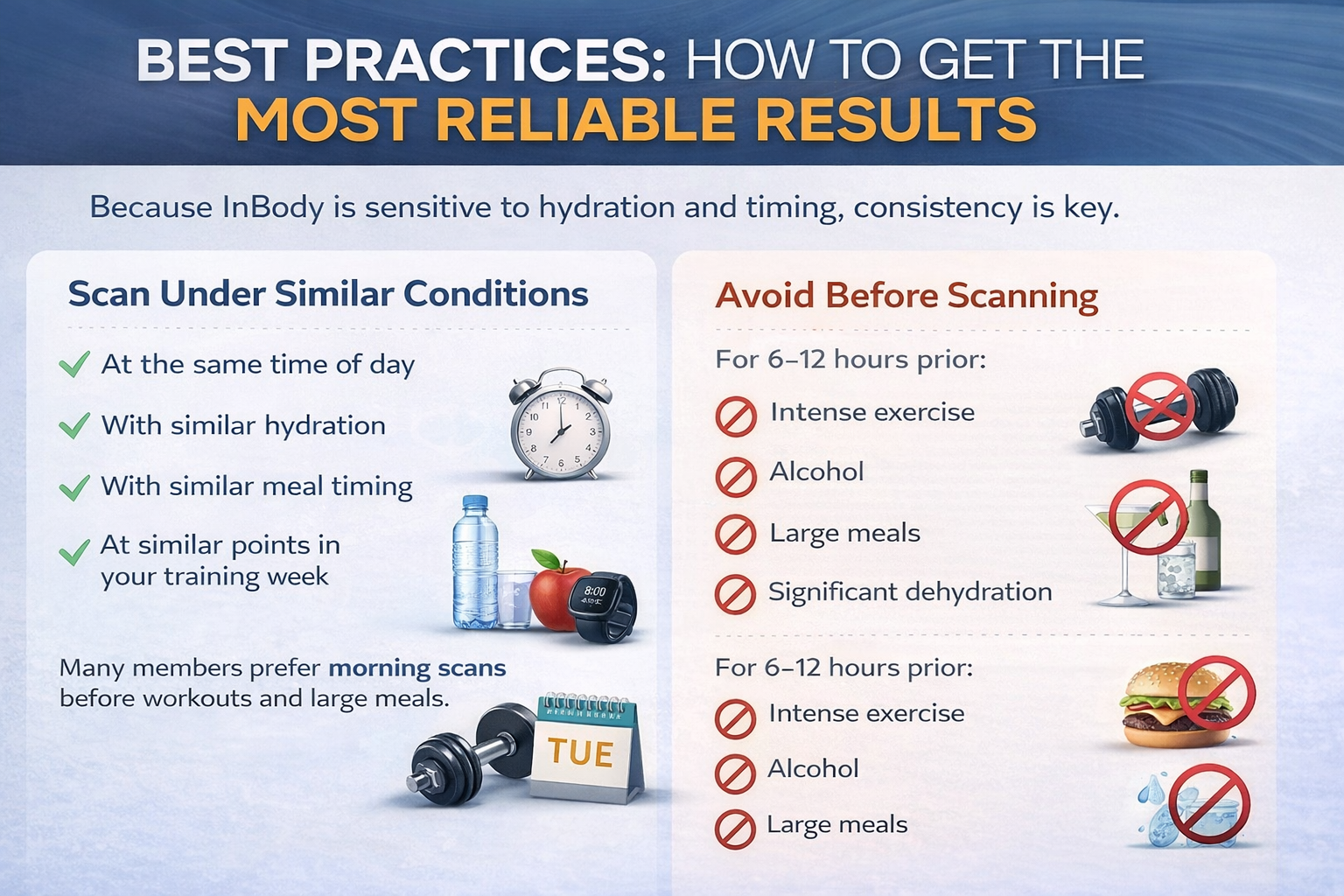
Best Practices: How to Get the Most Reliable Results
Because InBody is sensitive to hydration and timing, consistency is key.
Scan Under Similar Conditions
For best results, try to scan:
✔ At the same time of day
✔ With similar hydration
✔ With similar meal timing
✔ At similar points in your training week
Many members prefer morning scans before workouts and large meals.
Avoid Before Scanning
For 6–12 hours prior:
🚫 Intense exercise
🚫 Alcohol
🚫 Large meals
🚫 Significant dehydration
These can temporarily affect readings.
Wear Light Clothing
Remove shoes and heavy accessories to ensure good contact.
How Often Should You Use InBody?
More frequent scans are not always better.
Body composition changes gradually.
Recommended Frequency
For most members:
✔ Every 4–6 weeks → ideal
✔ Every 8–12 weeks → minimum
For structured programs:
✔ Every 2–4 weeks
Weekly scans often create unnecessary noise.
Focus on trends, not daily fluctuations.
Included With Your FITNESS SF Membership
InBody scans are included with your membership.
No extra fees.
No special packages.
No referrals.
It’s part of our commitment to helping members understand their bodies and train more effectively.
The Bottom Line
Bathroom scales tell you what you weigh. InBody helps show you what that weight represents.
With:
- Multi-point measurement
- Detailed muscle and fat analysis
- Segmental data
- Metabolic insight
- Reliable trend tracking
InBody gives you the tools to train smarter and eat better.
If you care about body composition, performance, or long-term health, it’s a no-brainer.
Ask a FITNESS SF team member about your complimentary InBody scan and start tracking your progress the right way.